The Shoutcast directory at shoutcast.com lists thousands of internet radio stations, and many listeners find new stations there. To be listed, your station needs a key from Shoutcast called an authhash. When you add that key to your Shoutcast server, your station appears in the directory.
Quick answer
- Get an authhash for your station from Shoutcast. As of October 2026, Shoutcast's Radio Manager is offline while Shoutcast builds a replacement, so new stations request one by email at
support@shoutcast.com. - Log in to your Shoutcast server's admin page (
http://your-server:port/admin.cgi), open Authhash, paste the key and click Save. - Keep the stream on air and set to public. The station appears in the directory.
What you need: a station running on a Shoutcast server (DNAS version 2), and its admin password. If your station is hosted on a CentovaCast control panel, that is usually your CentovaCast password.
1. Get an authhash
Previously, you created an authhash yourself in Shoutcast's free Radio Manager. That site is currently closed. Its page says Shoutcast is preparing a new broadcaster service, and that stations already listed keep streaming and stay in the directory.
What to do depends on your situation:
- Your station already has an authhash. Nothing changes. Your listing keeps working. If you move to a new server, enter the same authhash there (step 2); see the troubleshooting list below if the listing does not come back. Your hosting provider can usually see it in the control panel.
- You need a new authhash. Email
support@shoutcast.com(or use the form on the Shoutcast support page) and ask for your station to be listed. Include your station's name, genre, website, and the stream address (http://your-server:port). If you had a station ID before, include that too.
Treat the authhash like a password and do not post it publicly. Anyone who has it could attach a different stream to your listing.
We will update this guide when Shoutcast's new broadcaster service opens.
2. Add the authhash to your Shoutcast server
Open your Shoutcast server's admin page in a browser. The address is your server's hostname and your stream's port, followed by /admin.cgi:
http://your-server.example.com:8000/admin.cgi
Replace your-server.example.com with your server's hostname and 8000 with your stream's port. Both are shown in your hosting control panel.
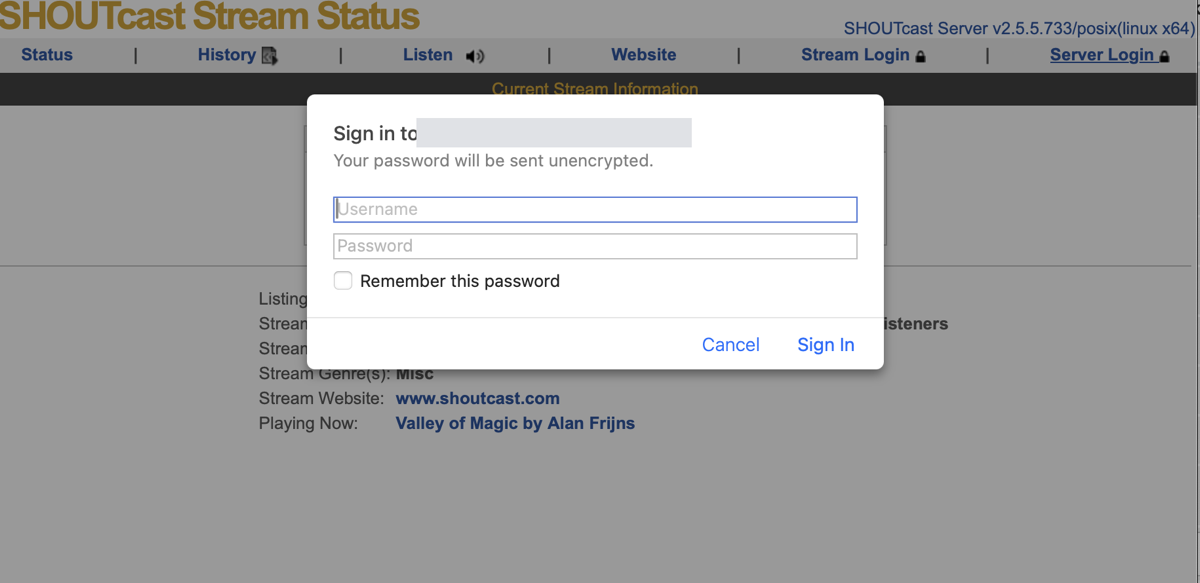
The stream status page opens. Click Server Login at the top right and sign in:
- Username:
admin - Password: your Shoutcast admin password (on CentovaCast, usually your CentovaCast password)
Click Authhash in the menu. Paste your authhash into the Authhash field and click Save.
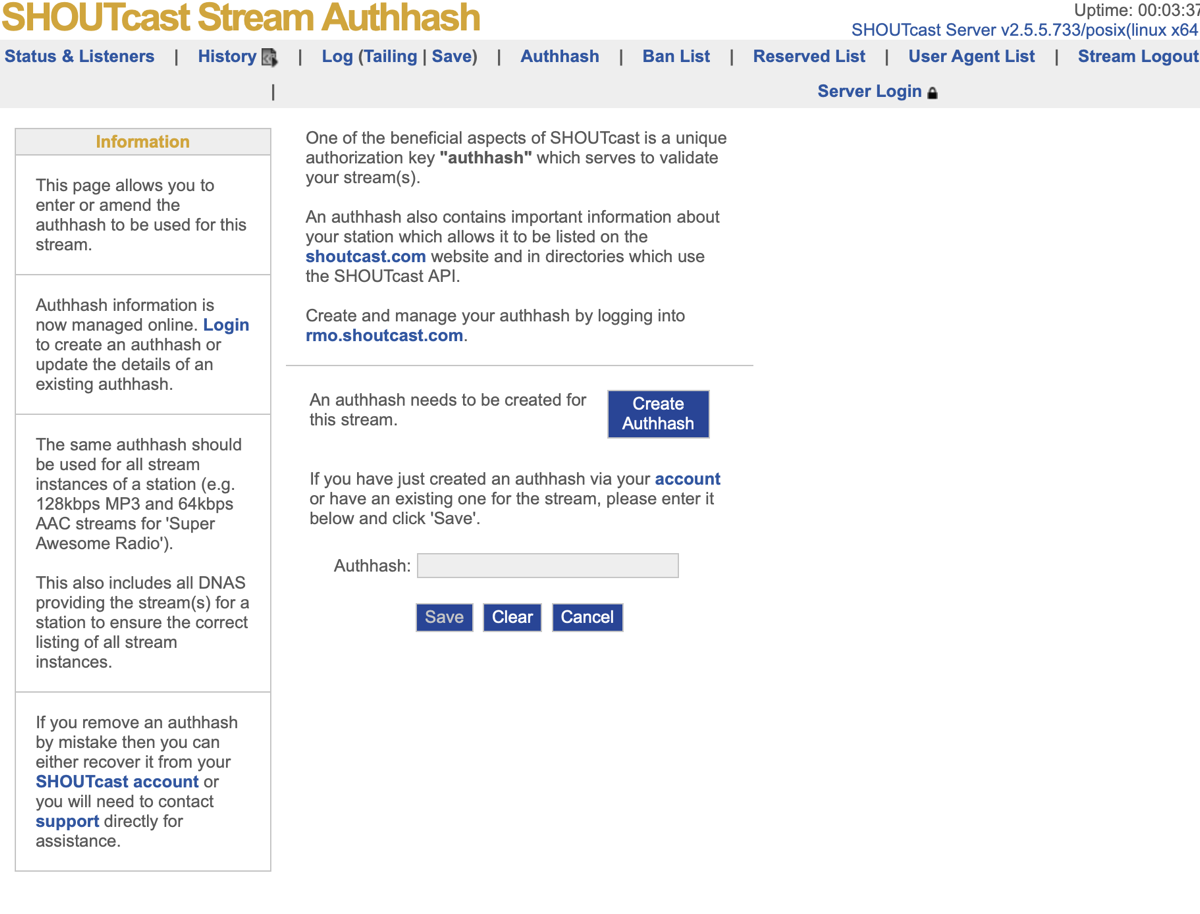
The Create Authhash button on this page links to Radio Manager, which is offline for now. You only need the Authhash field and Save.
3. Check your listing
The server now sends your station's details to Shoutcast. Your station usually appears in the directory within a few minutes, while the stream is on air. To find it, search for your station's name on shoutcast.com.
If your station does not appear
- The stream is off air. Only stations that are currently broadcasting are listed. Start your source (for example, AutoDJ or your live encoder) and check again.
- The server is set to private. The listing must be public. In CentovaCast, open your station's settings, set Public server to Always (or Default), save, and restart the stream.
- The authhash was not saved. Log in to
admin.cgiagain and check that the Authhash page shows your key. - You moved to a new server or IP address. An authhash is tied to the server it was first used on, so the listing may stop after a move. Enter your authhash on the new server; if the station still does not appear, email
support@shoutcast.comwith your station name and station ID. - You run several streams for one station (for example, a 128 kbps MP3 and a 64 kbps AAC stream). Use the same authhash on all of them, so they are listed together as one station.